
Straddle walkie stackers
The straddle is the highest volumes in Australian warehousing stacker market. Straddle machines use forward-extending stabiliser legs that position on either side of the pallet during a pickup. The weight of the load is transferred through the legs to the ground, providing a stable lifting base at a modest machine weight.
Straddle stackers are the standard choice for conventional pallet racking where aisle widths accommodate the leg footprint and loads are on standard pallet sizes. They are straightforward to operate, widely supported, and available across a broad capacity and lift height range.
Best for: Standard warehouse racking with bottom beams, even-aisle environments, operations with consistent pallet types and sizes.
Reach walkie stackers
A reach walkie stacker for sale uses a reach mechanism to extend the forks into the racking bay without the machine body moving into the rack face. The stabiliser legs remain in the aisle during stacking and retrieval.
The reach mechanism is more mechanically complex than the straddle design and sits at a higher acquisition cost.
Best for: Applications where the operation can’t have the straddle legs in front of the unit or don’t have the space between pallets or racking for the legs.
Counter-balance walkie stackers
A counter-balance walkie stacker for sale replaces the stabiliser legs with a heavy rear counterweight, using the same stability principle as a full-size counterbalance forklift. There are no forward legs to position around or below the pallet. The machine approaches the load directly and lifts without the leg clearance constraint.
Counter-balance walkie stackers are the appropriate choice when stabiliser legs cannot accommodate the load type: low rack positions, non-standard pallets, drums or IBCs, or floor-level storage formats that legs cannot straddle cleanly. The trade-off is higher machine weight and a generally lower maximum lift height at equivalent capacity compared with straddle designs.
Best for: Low rack positions, non-standard pallets, drum and IBC handling, floor-level storage formats incompatible with leg clearance.
Semi-electric versus fully electric walkie stackers
Within each of the design types above, walkie stackers for sale are available in semi-electric and fully electric configurations.
A semi-electric walkie stacker powers the lift function electrically but relies on the operator for travel propulsion. The operator pushes and steers the machine, while the electric lift removes the manual pump effort of a fully manual unit.
A fully electric walkie stacker powers both the lift and the traction, meaning the machine moves and lifts under its own power. The operator steers and controls speed, but no manual propulsion effort is required.
The choice between the two depends on travel distances and cycle frequency. Semi-electric is cost-effective for short-distance applications with moderate lift frequency. Fully electric delivers its return in operations where travel distances are meaningful, lift cycles are frequent, or operator fatigue over a full shift is a genuine consideration.
Why choose Toyota Material Handling?
Toyota Material Handling Australia supplies the full range of walkie stacker types across Australian operations.
Type first, specification second
Understanding which walkie stacker type is appropriate for an operation before comparing specifications within that type leads to a better procurement outcome. The right type, correctly specified, is a machine that works well in the facility from day one rather than one that requires workarounds for the application it was not designed to handle.
Contact Toyota Material Handling Australia to discuss the right walkie stacker for sale for your operation.
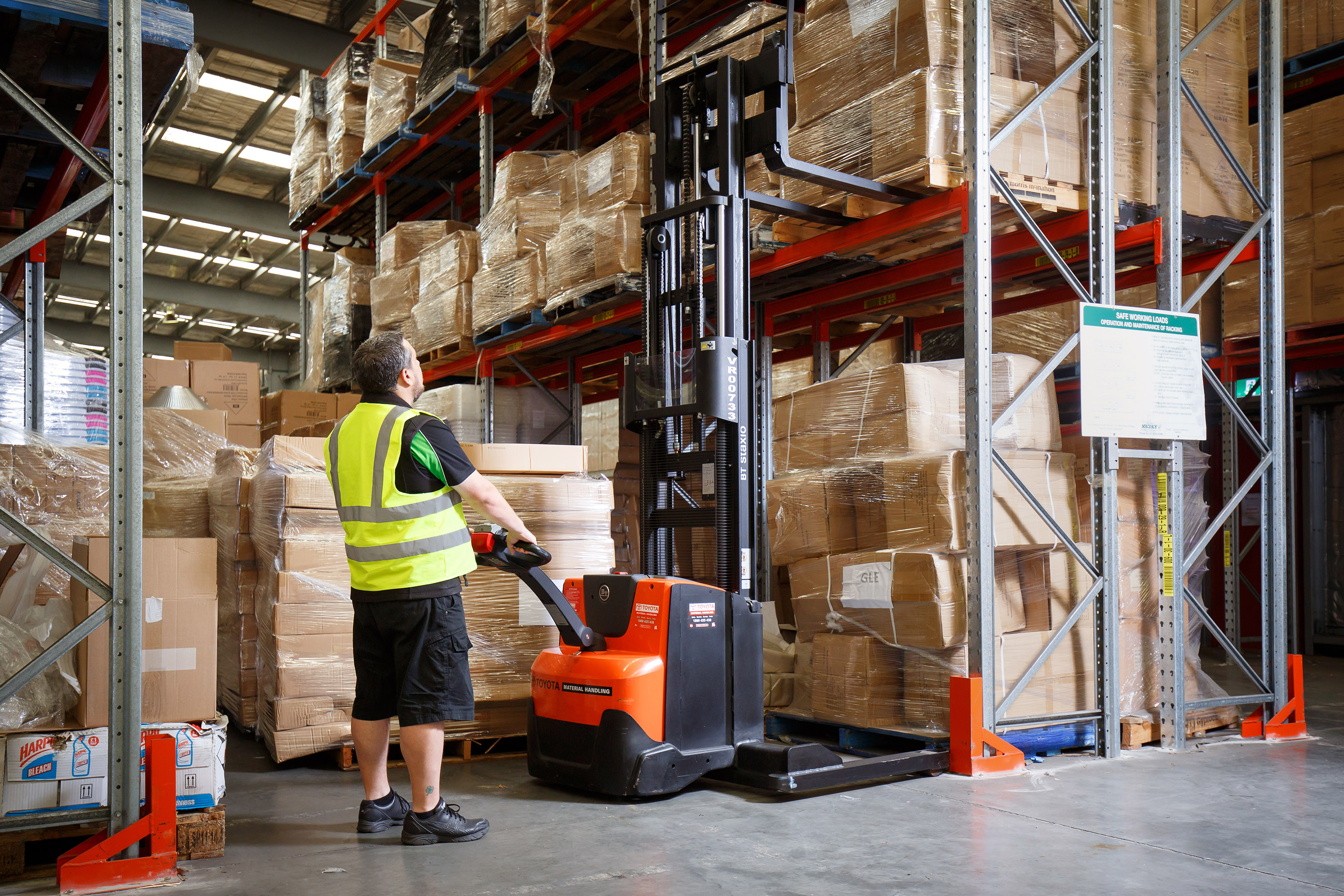
Choosing the right walkie stacker starts with understanding your application, as each design offers distinct advantages depending on your load type, racking configuration, and operating environment.