
Reverse travel in confined spaces
Pushing a loaded hand pallet jack into a tight space is typically safer than pulling it, because the operator can see the path ahead. The greater risk is reverse travel, pulling the jack back out while walking backwards with limited visibility behind.
Safe reverse travel practices in confined spaces:
Turning radius and spatial awareness
Hand pallet jacks require a turning radius proportional to their fork length. In tight spaces, the full turning arc needs to be planned before the operator begins the turn. Attempting a correction mid-turn in a narrow corridor typically results in the forks striking a fixed obstacle or the load shifting.
Where a full turning radius is not available, the safer option is to exit the space in the direction of entry and reposition rather than attempting a full turn in a confined area. Operators who try to force turns in insufficient space risk damaging racking, doorframes, or loads, and create a tipping risk if the jack rides onto an uneven surface mid-turn.
Floor surface hazards in tight spaces
Tight spaces are often the areas of a facility where floor condition receives least maintenance attention. Drainage grates, door thresholds, expansion joints, and worn surface areas are more common in back-of-house and loading areas than in main warehouse aisles.
Operating hand pallet jacks across uneven or transitional surfaces requires specific attention:
Pedestrian awareness in confined areas
Pedestrian and forklift conflicts are a leading cause of serious incidents in Australian warehouses. In tight spaces, the dynamic is similar for hand pallet jacks: an operator moving a loaded jack in reverse has limited visibility, and pedestrians moving quickly through a confined area may not see the load until they are very close to it.
Practical controls:
Equipment condition and tight-space safety
Equipment condition matters more in tight spaces than in open areas because the margin for error is smaller. A jack with worn wheels that pulls to one side is manageable in an open aisle. In a confined space, the same fault creates a real collision risk.
Pre-start checks on hand pallet jacks used in tight-space applications should confirm wheel condition and rolling straightness, fork integrity, and tiller handle response. Faults should be reported and the equipment taken out of service until repaired.
Why choose Toyota Material Handling?
Toyota Material Handling Australia provides the full range of manual and electric pallet handling equipment suited to confined and tight-space applications, from compact units designed for narrow corridors to full-specification models for high-throughput distribution environments.
Technique, not just rules
Safe operation of hand pallet jacks in tight spaces is a product of deliberate technique applied consistently, not just compliance with posted rules. Operators who understand the spatial demands of the equipment, plan their entry and exit, and maintain awareness of pedestrians and floor conditions reduce incident risk on every shift.
Contact Toyota Material Handling Australia to discuss equipment, training, or service support for your operation.
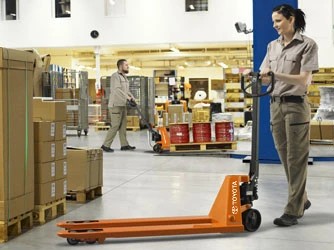
Safe hand pallet jack operation in confined spaces relies on planning movements, maintaining visibility, controlling speed, and staying aware of pedestrians, equipment condition, and floor hazards.